
Product Vibing 2.0. Not just an experiment
AIRESEARCHPRODUCT VIBING
A year ago I had a hypothesis.
Could one person, partnering with AI, build an entire product from idea to launch?
Not just the code.
The product strategy.
The user experience.
The interface.
The copy.
The branding.
The development.
The testing.
The marketing.
I wanted to know whether AI had fundamentally changed what one person could create.
If I was going to test that hypothesis, there was only one product that made sense to build. A product that helps people learn how to build with AI. That product became Product Vibing.
Looking back, I realise Product Vibing wasn’t just the outcome of the experiment.
It became the proof.
The first version did exactly what it needed to do
When I look back at Product Vibing 1.0, I don't see an outdated website, I see evidence. Evidence that one person, working alongside AI, could build something that previously would have required a team.
Version 1 achieved exactly what I hoped it would.
It proved the concept.
More importantly, it gave me something even more valuable.
A year of learning, it taught me:
Where people hesitated.
What they ignored.
What they valued.
What I would never design that way again.
Version 1 wasn’t a mistake, it was the research.
The product no longer reflected how I thought
As the months passed, something interesting happened. My thinking evolved faster than the product itself. Over the last year I’ve spent countless hours exploring what Human-led AI really means.
Not as a slogan. As a practical way of designing products.
When I revisited Product Vibing, I realised I wasn’t looking at bad design. I was looking at the product I was capable of designing twelve months earlier.
The biggest changes weren’t visual, they were conceptual. Originally the recommendations were organised by skill level.
Beginner.
Intermediate.
Advanced.
At first, that seemed logical, until I realised something.
People don’t wake up thinking:
“Today I’d like to become Intermediate.”
They wake up thinking:
“I need to validate an idea.”
“I need to improve this experience.”
“I need to build an MVP.”
“I need to write better copy.”
People don’t think in skill levels. They think about what they’re trying to accomplish. That single realisation changed almost everything. The recommendations became an AI Playbook.
The assessment became simpler.
The journey became clearer.
The product stopped classifying people.
It started guiding them.
Each stage had a different purpose.
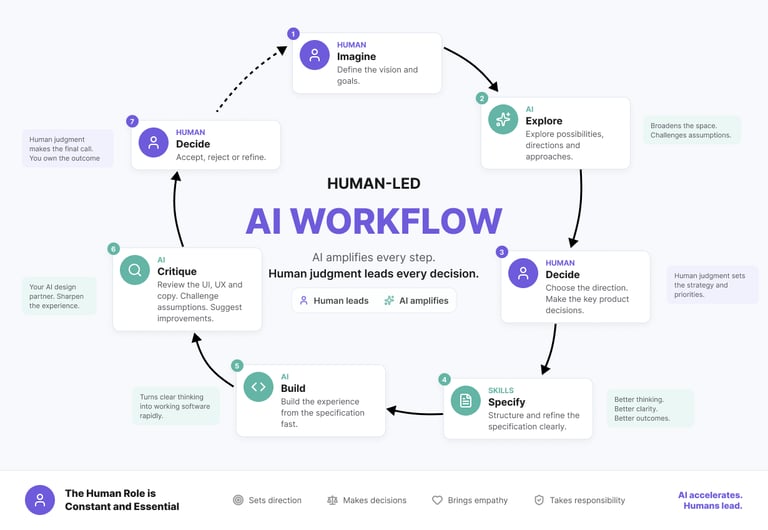
AI (Claude Design) helped me explore far more design directions than I could have explored alone.
Once I had confidence in the direction, I used structured skills (SpecKit) refined my thinking before building anything.
Better thinking produced better specifications. Better specifications produced better outcomes. AI (Cursor) then accelerated the implementation.
But the part that surprised me most happened after the build. I began using AI (Claude browser extension) as though it were another Senior Product Designer. Not to redesign the product.
To critique it.
It questioned my hierarchy.
It challenged my copy.
It highlighted inconsistencies.
It suggested alternative approaches.
Sometimes I agreed.
Sometimes I didn’t.
But every critique forced me to explain why I’d made a decision.
That iterative feedback loop became one of the biggest improvements to my workflow.
AI didn’t replace product thinking.
It strengthened it.
The mission never changed
Almost everything changed between Product Vibing 1.0 and Product Vibing 2.0.
The assessment.
The results.
The information architecture.
The visual design.
The technology.
But one thing remained constant.
The mission. Product Vibing still exists to help people learn how to build with AI.
Everything else was simply a better way of achieving that goal.
AI changed my workflow, not my responsibility
The biggest lesson wasn’t that AI could write code. It was that AI became a genuine design partner. Not a replacement, a partner.
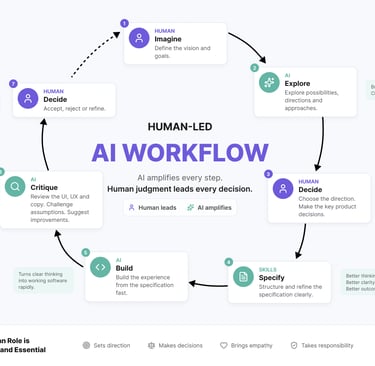
Over time I developed a workflow that looked something like this.
The experiment wasn’t what I thought it was
When I started Product Vibing, I thought I was running an experiment to prove that one person could build an entire product with AI.
A year later, I realised that wasn’t the experiment at all. The real experiment was learning how to partner with AI.
Not as a coding assistant.
Not as a design generator.
But as a collaborator that could explore ideas, accelerate execution, challenge assumptions and sharpen thinking.
The technology mattered.
The product mattered.
But neither was the biggest lesson. The biggest lesson was this. AI hasn’t changed why I build products. It has changed how I build them.
Building is becoming cheaper.
Iteration is becoming faster.
Exploration is becoming almost free.
Which means something else becomes more valuable.
Thinking.
Because when AI makes building easier, the competitive advantage is no longer simply being able to build.
It’s knowing what deserves to be built.
That is the lesson I’ll carry into every product I build from here.


Join the conversation
Visit my LinkedIn post:
Follow me
Idea's that drive innovation through curiosity
© 2025. All rights reserved. | Copyright and Terms of Use Agreement
Resources
- Blog
- Free Tools